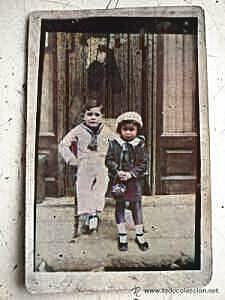
Source: Todo Colección
Source: Todo Colección
(Cantares Gallegos, 1863)
"San Antonio bendito" like most poems of Cantares Gallegos employs the affectionate diminutive form peculiar to the Galician language—singular termination iña (feminine) or iño (masculine). Not every word that ends in iña or iño is an affectionate diminutive however.
All the words in "San Antonio bendito" that end in iña or iño are listed below together with a range of possible translations and a short explanation of the choice that was made. Galician affectionate diminutives lend the translator an opportunity to add alliteration, internal rhyme and lyrical sharpness to the text. The objective is to find the best adjective, adverb or noun which conveys smallness, frailty, concern or affection depending on the context. This objective ends in a personal choice when more than one translation is available as is often the case. Sometimes an affectionate diminutive is best ignored because the context is unclear, because the extra term jars the smooth flow of the translation or because it makes the text too syrupy. The exercise can be fun, difficult and challenging. The extra work is worthwhile because it offers the English reader an approximation to what De Castro called "those tender words and those idioms never forgotten which sounded so sweet to my ears since the cradle and which were gathered up by my heart as its own heritage."
Saint Anthony (title). Reputed to be a matchmaker in Portuguese and Brazilian tradition.
troncho que troncho (4.7). A troncho is the stalk of a garden vegetable like cabbage, but colloquially it can also denote derision or exhaustion. Walking-stick kale can grow as tall as a person. It was traditionally used for making walking sticks. Hence this cabbage can be a pun and a metaphor for muscle stiffness, fatigue and trudging or clumping along.
Virxe do Carme (5.2). The Spanish religious icon known as Our Lady of Mount Carmel, patron saint of sailors.
This poem was arranged by composer Joaquín Rodrigo in 1951. The piece is performed below by singer Laura Alonso Padín and musician Cristina Pato at the piano.
Laura Alonso Padín and Cristina Pato
|
San Antonio bendito,
Meu santo San Antonio
Daimo, meu santo,
Unha muller sin home...
Mais en tendo un homiño,
Eu sei dun que cobiza
Por el peno de día,
Facé, meu San Antonio,
¡Ai, meu santiño!
San Antonio bendito,
Que, zambo ou trenco, |
Blessed Saint Anthony,
My saintly Saint Anthony,
Bring him, my saint,
A woman without a man—
But with a greenhorn for mate—
I know of someone whom to see
For him I ache by day,
Bring him to me,
Please, my cherished saint!
Blessed Saint Anthony,
Even bowlegged or knock-kneed, |