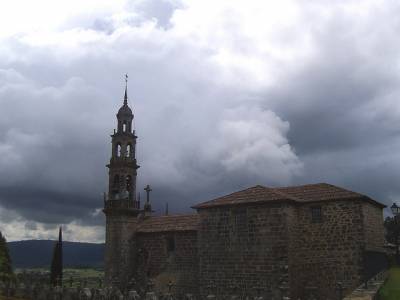
Source: Amaianos' photostream. flickr
Source: Amaianos' photostream. flickr
(Cantares Gallegos, 1863)
Another acceptable way of spelling Bastabales is Bastavales; the name derives from the Latin "vasta vallis" meaning "vast valley."
Original line 1.5.1 reads, "Non me roubaron, traidores," which makes stanzas 1.5-1.6 say, "Treacherous loves sweetly mad alas! / Sweetly mad loves alas! / Did not abduct me. / For love has fled / And loneliness arrived... / Consuming me with grief." The statement is incongruous and begs the question, "Then who abducted the protagonist?" Changing one crucial vowel in line 1.5.1. clears up the confusion. What De Castro wrote in fact was: "Non me roubaran, traidores," and the typesetter mistook the highlighted "a" for an "o" and the error is understandable because this video demonstrates that De Castro's caligraphy sometimes produced a's that look like o's when joined to a consonant.
De Castro was the illegitimate daughter of Father José Martínez Viojo and of María Teresa da Cruz de Castro e Abadía. He was born in 1798 in the hamlet of Ortoño and he died at the age of seventy-three in Iria Flavia. She was born in 1804 at Iria Flavia, 2 kilometers away from Padrón, and she died at the age of fifty-seven in Santiago de Compostela.1 Father Viojo and María Teresa kept seeing each other after Rosalia's birth.
The bells of Bastavales are audible in Ortoño, 3 kilometers away, but they can not be heard in Padrón (12 kilometers away) or in Santiago de Compostela (16 kilometers away). Hence De Castro must have lived in Ortoño long enough to retain a conscious remembrance of the bells. It is certain that she was cared for there until the age of four. Then she was sent to live with her mother and go to school in Padrón. This poem certifies that she returned to Ortoño during the summer holidays. Furthermore her frequent allusions to the river Sar testify that the child had a wonderful time playing on its banks. In addition Viojo`s relatives hailed from Bastavales, guaranteeing that the child went along on family visits there. Indeed the conviction persists among some neighbours of Bastavales that De Castro eventually took up residence in the neighbourhood (source: xensboy, uploader of a Youtube video entitled, "The ringing bells of Bastavales in the summer of 2010," since removed).
The following excerpt of a letter written by Luis Tobío in 1923 affirms that De Castro was acquainted with her father,
When my aunt was 19 years old, in the spring of 1859, she returned from school at noon and went as usual into the house where she lived with her uncle, and she bumped into Rosalía chatting with her father in the living room. She retired prudently—this was the first time that she had seen her cousin. She told me that her first impression [of De Castro] was that of a good-enough girl, neither very pretty nor homely, tall and charming.2
Tobío's letter elucidates many things. For example the line, "mill in the chestnut forest," of poem 4, "Adiós rios, adios fontes," tabs the watermill owned by Viojo's family. The letter portrays Rosalía's father as a "tall, swarthy, plump, ironic and engaging" man and it discloses that María Teresa had intended to abandon De Castro in a baby-drop-off facility run by the church, but that the father intervened and sent the newborn to Ortoño instead, first under the care of a tailor, and subsequently into the care of his own family.
To plot the trip taken by the protagonist of this poem, "Campanas de Bastabales," the reader must concede the premise that "yonder" (1.4.2-3) is Ortoño or more generally the valley known as Val da Mahía which encompasses both Ortoño and Bastavales. The protagonist no longer dwells there and she must cross hillocks to reach the valley (2.1.2). Where does she dwell now? Section V provides the important clue that clouds rush toward her house (5.1.2-3). The usual direction of strong winds accompanied by cloudy weather in Val da Mahía is southwesterly or westerly. Therefore her home must lie east of Bastavales, be within walking distance and beyond a range of hills. Santiago de Compostela is the only one of De Castro's known addresses that fits. Thus it is posited that the poem depicts a journey from Santiago de Compostela to Bastavales.
"Campanas de Bastabales" has this background script. Section I voices De Castro's regret at having left Bastavales lured by her "treacherous, sweetly mad love" for Manuel Murguía. The couple married in Madrid in 1858 and settled down in Santiago de Compostela the following year.3 Section II starts her real or imaginary walk from the city to her beloved hamlet. In sections III and IV she exults as she strolls toward Bastavales. Surprisingly she does not reach her destination: nightfall finds her seated on a small boulder by the trail, a cue that the trip is in fact a poetic escapade. Section V reflects her anguish at having been left alone in Santiago de Compostela. Her neighbours there are uncaring ("without a friend") her husband is away ("for whom I live pining") and her mother is dead ("everyone has departed").4 Under this script the Ave María of the last two stanzas is rung by the bells of St. James' Cathedral.
The peculiar dashed line set near the poem's close may signal the excision of lines that are too revealing.
"Campanas de Bastabales" as do most poems of "Cantares Gallegos" makes extensive use of the affectionate diminutive form peculiar to the Galician language—singular termination iña (feminine) or iño (masculine). Notice that not every word that ends in iña or iño is an affectionate diminutive.
All the words in "Campanas de Bastabales" that end in iña or iño are listed below together with a range of possible translations and a short explanation of the choice that was made. Galician affectionate diminutives lend the translator an opportunity to add alliteration, internal rhyme and lyrical sharpness to the text. The objective is to find the best adjective, adverb or noun which conveys small size, frailty, concern or endearment depending on the context. This objective ends in a personal choice when more than one translation is available as is often the case. Sometimes an affectionate diminutive is best ignored because the context is unclear, because the extra term jars the smooth flow of the translation or because it makes the text too syrupy. The exercise can be fun, difficult and challenging. The extra work is worthwhile because it offers the English reader an approximation to what De Castro called "those tender words and those idioms never forgotten which sounded so sweet to my ears since the cradle and which were gathered up by my heart as its own heritage."
Soidades (refrain, line 3). The best translation may be "to have the blues." Soidá, saudade is dejection triggered by solitude, separation or frustration. At the beginning of the poem "soidades" bespeaks her longing to see Bastavales, at the close her loneliness.
as laradas das casiñas (5.3.2). It was customary to kindle a small blaze (larada) by the gate of a house to protect the place from evil spirits or natural dangers.1
The call of the Ave María (5.3.6). That is the Angelus which was rung three times a day: 6:00 AM, noon and 6:00 PM.
Troubadour and songwriter Amancio Prada arranged sections I and III of the poem. The audio of the first entry is from his 1997 album, "Rosas a Rosalía." Casablanca Choir and separately Mary C. Otero Rolle cover Prada on the next two entries. The audio of the fourth entry is from Prada's 1991 album, "Trovadores, Místicos y Románticos." Soprano María Orán offers an operatic interpretation of section I last.
Amancio Prada, María del Mar Bonet and the Galicia Symphony Orchestra. This song recites section I.
Amancio Prada. This song recites section III.
María Orán and the Extremadura Symphony Orchestra render section I as a cantata.
|
Campanas de Bastabales, I
Cando vos oio tocar,
Cando de lonxe vos oio,
Dóiome de dor ferida,
Solo media me deixaron
Non me roubaran, traidores,
Que os amores xa fuxiron, II
Aló pola mañanciña
Como unha craba lixeira,
A pirmeira da alborada
Por me ver menos chorosa,
Queixumbrosa e retembrando
E pola verde pradeira, III
Paseniño, paseniño,
Camiño do meu contento;
E sentada estou mirando
Cal se deita, cal se esconde,
Para donde vai tan soia,
Que si oíra e nos falara, IV
Cada estrela, o seu diamante;
Diante marcha crarexando
Falta o día, e noite escura
De verdura e de follaxe,
Do ramaxe donde cantan
Que ca noite se adormecen V
Corre o vento, o río pasa;
Miña casa, meu abrigo:
Eu me quedo contemprando
Elas tocan pra que rece;
Campanas de Bastabales, |
Bells of Bastabales, I
When I hear you ring,
When I hear you afar
I hurt wounded by pain,
Just half alive left me they
Would that treacherous loves sweetly mad alas!
For love has fled II
In the early morning hours
Fleet-footed like a she-goat
The dawn's first which
They fetch it on their wings,
Groaning and reverberating
And over the green prairie, III
I make my way to Bastabales,
Pathway of my delight;
And seated I am watching
How it lies low, how it hides,
Where does she head to so alone
For if she heard and talked to us IV
The moon marches on, forlorn,
She marches on brightening
It's the close of day, and the dark night
Of greenery and leafage,
Of the many branches where sing
That fall asleep at night V
By rushes the wind, the river flows by,
My house, my shelter:
I am left watching
They summon me to prayer;
Bells of Bastabales, |