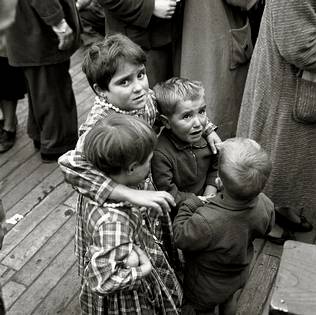
Source: Os Adeuses. Photographs of Galician emigration by Alberto Martí.
Mediateca: Consello da Cultura Galega
Source: Os Adeuses. Photographs of Galician emigration by Alberto Martí.
Mediateca: Consello da Cultura Galega
(Cantares Gallegos, 1863)
Theme
"Good-bye rivers, good-bye fountains" recounts the drama of those forced to emigrate by the crisis of 1850-1860.
"Good-bye rivers, good-bye fountains" recounts the drama of those forced to emigrate by the crisis of 1850-1860. Apparently due to the unusually cold winters of the decade 1850-1860 and due to the prevalence of subsistence agriculture many family farms of Galicia went bankrupt. To compound the problem the domestic textile industry also spiralled into crisis.
In December 1836 the first commercial ad appeared offering transatlantic passage aboard the General Laborde from A Coruña to Montevideo/Buenos Aires. Transatlantic voyages increased steadily. Most were made on sailing ships. Somewhat reliable data suggest that 93,040 Galicians departed between 1836 and 1860. The Spanish government legalized emigration in 1853, and this made the count reliable: 122,875 people abandoned Galicia between the years 1860 and 1880.(André Solla. "A emigración galega a América")
The volume of emigration over the period 1836-1880 was staggering. The Galician census of 1857 gave a count of 1,776,879 people. Hence about 12% of the people emigrated.
This sentimental poem makes use of the affectionate diminutive form peculiar to the Galician language profusely. The affectionate diminutive has the singular termination iña (feminine) or iño (masculine). However not every word that ends in iña or iño is an affectionate diminutive.
All the words in "Adiós rios, adios fontes" that end in iña or iño are listed below together with an explanation of the translation made where needed. Galician affectionate diminutives offer the translator an opportunity to add alliteration, internal rhyme and lyrical sharpness to the text. Usually there is no one rigorous translation of an affectionate diminutive; consequently the goal is to select the best adjective, adverb or noun which conveys smallness, frailty, concern or affection, depending on the context, and which simultaneously embellishes the poem in the translator's eyes.
Virxe da Asunción (8.1, 8.5). The Spanish religious icon known as Our Lady of the Assumption (to heaven).
Pomar (9.2). Also known as Pumar it is a hamlet in county Rois, some 20 kilometers away from Santiago de Compostela. It was so small that one local ditty chaffed it with these words, "Although from a distance the hamlet of Pumar looks like a town it has but a carnation on the way in and a rose on the way out." Another ditty is more generous, "They say that Pumar is uncomely because its houses do not have balconies, yet it has pretty girls who steal away hearts."1
Troubadour and songwriter Amancio Prada recorded a version of this poem accompanied by the Galicia Symphony Orchestra (first entry). Singer-songwriter Manoele de Felisa covers Prada's version on the second entry. María Xosé Silvar (stage name Sés) sings the full poem on the third entry.
Amancio Prada and the Galicia Symphony Orchestra from the 1997 album Rosas a Rosalía.
Manoele de Felisa from the 1999 album Orballo.
Sés live at Teatro Colón (A Coruña) on February 25, 2018.
Los Hijos de La Casa Grande (min. 6:35 onward).
|
Adiós, ríos; adios, fontes;
Miña terra, miña terra,
¡Adios groria! ¡Adios contento!
Deixo amigos por estraños,
Mais son probe e, ¡mal pecado!,
Téñovos, pois, que deixar,
Adios, adios, que me vou,
Adios Virxe da Asunción,
Xa se oien lonxe, moi lonxe,
Xa se oien lonxe, máis lonxe,
¡Adios tamén, queridiña!...
Non me olvides, queridiña, |
Good-bye rivers, good-bye fountains;
My land, my land,
Good-bye heaven! Good-bye happiness!
I leave friends for strangers,
But I am poor and—base sin!—
I must therefore leave you,
Good-bye, good-bye, I am leaving,
Good-bye Virxe da Asunción,
Far, very far away, are heard
They are heard afar, farther away,
Farewell to you too, little darling!...
Don't forget me, little darling, |