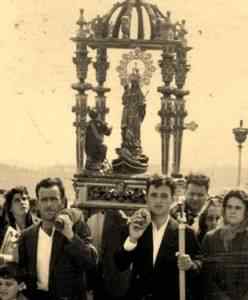
Source: La romería, entre la fé y la leyenda.
Galicia Unica. July 13, 2012
Source: La romería, entre la fé y la leyenda.
Galicia Unica. July 13, 2012
(Cantares Gallegos, 1863)
Legend has it that the fishing village of Muxía was the final place a fatigued Saint James reached when he came preaching to Spain. He waded into the cold ocean water up to his knees wondering whether his missionary outreach would bear fruit. As he pondered full of doubt he spied a sailing boat made of stone approaching, carrying a woman cloaked in black. The woman was Mary the mother of Jesus. She congratulated the apostle on his epic journey and urged him to return to Jerusalem by the same route he had taken. James obeyed and departed after ordering the villagers to erect a chapel in Mary's honour.
A stony slab reputed to be the hull of that legendary boat rocked and huffed when, according to tradition, anyone in state of grace stood upon it, declining to do so for someone in state of mortal sin. The slab was struck by lightning a few years ago and no longer operates.1 Nearby an arched boulder, reputed to be the boat's sail, is said to heal the kidneys of those who crawl under it nine times.
Muxía and five other villages mentioned in this poem, "Nosa Señora da Barca," lie on a stretch of coast known as the "Coast of Death" for its dangerous waters and high incidence of shipwrecks, the more famous of which were H.M.S. Captain (September 7, 1870), H.M.S. Serpent (November 10, 1890), the Panamanian freighter Casón (December 3, 1987) and the oil tanker Prestige (November 19, 2002).

Federico García Lorca paid homage to Our Lady of the Barge in his poem, "Romaxe de Nosa Señora Da Barca," published in 1935. It is one of his Seis poemas gallegos,
|
¡Ay ruada, ruada, ruada
A Virxen era pequena
Pombas de vidro traguían
¡Virxen, deixa a túa cariña
Pol-a testa de Galicia
¡Ay ruada, ruada, ruada |
Ah, street outing, street outing, street outing
The Madonna was small
Pigeons of glass were fetching
Our Lady, leave your lovely face
Anon across Galicia's forehead
Ah, street outing, street outing, street outing |
Amancio Prada and Cantigas E Agarimos.
Marful, before the sarcophagus of Daniel Castelao in the Pantheon of Illustrious Galicians.
"Nosa Señora da Barca" is one of the poems in the volume "Cantares Gallegos" that employs the affectionate diminutive form peculiar to the Galician language most often. The affectionate diminutive—singular termination iña (feminine) or iño (masculine)—makes translating harder and something of artwork, but to yield to the temptation of treating it as a nuisance and ignoring it is to rob the translation of the full emotion with which the author wrapped her description of the festivities in honour of Our Lady of the Barge.
All the words in "Nosa Señora da Barca" which end in iña or iño are listed below together with a range of possible translations and a short explanation of the choice made where useful. Galician affectionate diminutives provide the translator with an opportunity to add alliteration, internal rhyme or lyrical sharpness to the text. The aim of the translator is to find the best adjective, adverb or noun which conveys size, frailty, sympathy or endearment according to the context.
Para tocar o pandeiro (1.7.11). In Galicia a pandeiro is a square or rectangular board which is held between the arms and tapped with both hands (min. 2:55-2:57, 3:26-3:30 and 3:34-3:38 of this video).
Virxe do Carme (1.8.1). The Spanish religious icon known as Our Lady of Mount Carmel, patron saint of sailors.
And of the gunpowder shells exploding (2.1.10). The word "bombas" is translated "gunpowder shells" rather than "fireworks" because fireworks typically are associated with some sort of dazzling visual display whereas these "bombas" are used exclusively to make noise.
Aqueles dulce resolio (2.1.13). Resolio (literally "pant") was a strong liquor made from aniseed with an alcoholic content above 40% closely related to pastis, today it is a collector's item.
Ó son da alegre pandeira (2.1.18). A pandeira is a tambourine twice the diameter of a normal one.
Con rosquilliñas de almendra (2.1.14). Almond-cookie rings.
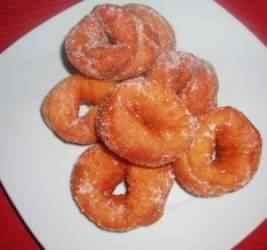
Source: Rosquillas de almendra. Robot de cocina: Thermomix
The traditional folk song to Our Lady of the Barge in Muxía is performed below by the female half of the group O Fiadeiro (first entry). In the second entry Coral De Ruada sings a traditional song whose second cycle copies the second stanza of Lorca's "Romaxe de Nosa Señora Da Barca." In the third entry Luar Na Lubre incorporates the refrain of De Castro's "Nosa Señora da Barca." Portuguese troubadour Augusto Madrugada sings the medieval romance, "Nossa Senhora da Barca," on the fourth entry. In the fifth entry Ana Kiro (b. 1942, d. 2010) sings "Romería en Muxía" (Festive Pilgrimage in Muxía).
O Fiadeiro (to min 2:00).
Coral De Ruada (Note: singing starts on min. 2:40).
Luar Na Lubre from the 2007 album Camiños da Fin da Terra.
Augusto Madrugada from the 2008 CD Na memória que se alonga.
Ana Kiro from the 2013 album Grandes Éxitos, Vol. 1.
María del Carmen Sánchez Martínez (Centro Gallego de Palma de Mallorca).
|
Nosa Señora da Barca I
¡Canta xente..., canta xente
¡Que lanchas tan ben portadas
Todos cargadiños veñen
¡Cantos dengues encarnados!
¡Canta maxesa nos homes!
As de Muros, tan finiñas,
As de Camariñas visten
As de Cé, ¡Virxe do Carme!,
Son as de Laxe unhas mozas...
As de Noia ben se axuntan
Xa que fosen de Rianxo, II
Ramo de froles parece
¡Bendita a Virxe da Barca,
A pedra, bala que bala,
Cando as campanas repican
Nosa Señora da Barca |
Our Lady of the Barge I
How many people...how many people
Such well-skippered boats
All come fully loaded
How many carmine shawls!
Such elegance in the men!
The girls of Muros, so fine and so dainty
The girls of Camariñas dress
The girls of Cée—Virxe do Carme!—
The girls of Laxe are some lasses...
The girls of Noia mingle well with
Whether they were from Rianxo, II
Muxía of the high crags
Blessed Lady of the Barge,
The huge slab, wobbling and wobbling,
When the bells peal
Our Lady of the Barge |