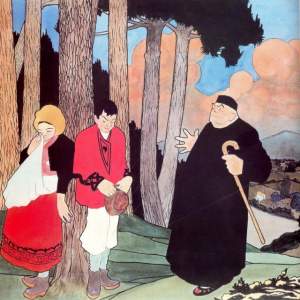
Source: Hai que casarse. Alfonso Daniel Rodríguez Castelao.
All Paintings Home
Source: Hai que casarse. Alfonso Daniel Rodríguez Castelao.
All Paintings Home
(Cantares Gallegos, 1863)
"Díxome nantronte o cura que é pecado" could not be an exception and it too contains many affectionate diminutives. The affectionate diminutive peculiar to the Galician language ends in iña (feminine) or iño (masculine). Notice that not every word that ends in iña or iño is an affectionate diminutive.
All the words in "Díxome nantronte o cura que é pecado" that end in iña or iño are listed below together with a range of possible translations and a short explanation of the choice that was made. Galician affectionate diminutives lend the translator an opportunity to add alliteration, internal rhyme and lyrical sharpness to the text. The objective is to find the best adjective, adverb or noun which conveys small size, frailty, concern or endearment depending on the context. This objective ends in a personal choice when more than one translation is available as is often the case. Sometimes an affectionate diminutive is best ignored because the context is unclear, because the extra term jars the smooth flow of the translation or because it makes the text too syrupy. The exercise can be fun, difficult and challenging. The extra work is worthwhile because it offers the English reader an approximation to what De Castro called "those tender words and those idioms never forgotten which sounded so sweet to my ears since the cradle and which were gathered up by my heart as its own heritage."
Jacinto (5.3). Hyacinth, not a common first name in English.
Cara de pote fendido (10.1). "Cara de pote" was slang for an object of dark complexion (an overcast day, a face) because the cooking pots of Rosalia's day were ironwork. The modifier "fendido" (from fenda: slit, crack, chink) may tab the light-coloured areas of Jacinto's face (teeth, white of the eyes) or a scar. Thus the translation, "crackpot face," is wrong. Jacinto is not a nutter but a gypsy probably.
tan contento (23.2). Although the literal translation is, "so merrily," a better rendition is "without a second thought," or "without a care in the world." The first option, "without a second thought," serves to contrast Jacinto's indifference with the infatuated girl's constant dwelling upon him.
The Galician countryside regarded a parish priest with ambivalence. He was highly respected when he helped the poor, assisted them in their dealings with the law or looked after the basic education of the children. He was the butt of prudent jokes otherwise. In any case the Galician countryside did not expect a parish priest to be celibate; celibacy was deemed unnatural. Instead the rural priest is a stereotype of covert profligacy in many traditional songs, as for example in the refrain of the xota de Soutomaior which states,
|
Eu non vou, non vou, |
I won't go, I won't go, |
|
Díxome nantronte o cura
Dálle que dálle ó argadelo,
Sempre malla que te malla,
Canto máis digo: ¡Arrenegado!
Máis ansias teño, máis sinto,
Porque deste ou de outro modo,
¡Que é pecado...miña almiña!
Nin podo atopar feitura
Din que parés lagarteiro
«Cara de pote fendido»
Si elas cal eu te miraran,
Vino unha mañán de orballo,
Arrimeime paseniño
E tiña a boca antraberta,
I as guedellas enrisadas
¡Meu Dios! ¡Quen froliña fora
¡Quen xiada, quen orballo
Mentras que así o contempraba
Bate que bate, batía
E volveu a rebulir
Dempois, chora que te chora,
E non me namora, non,
E vai tras de outras mociñas
E que queira que non queira,
¡Sempre malla que te malla
Por eso, anque o cura dixo |
The day before yesterday the padre
Turn and turn the swift,
Thresh and thresh evermore,
The more I say, "Renegade!
The more I fret, the more I grieve
Because one way or another,
That it's a sin...my poor soul!
I can't finish the chores
They say you look
"Cracked-cooking-pot face"
If the girls saw you as I do,
In the early hours of a drizzly morn
I laid down beside him
He had the mouth half open,
And the curled locks
My God! Who were one
Who frost, who drizzle
He stirred
Beating, beating, it beat
And he stirred again very slowly,
Afterwards I wept and wept
And no, he doesn't woo me—
And he chases the other lassies
And willy-nilly
Thresh and thresh evermore
That is why although the padre said |