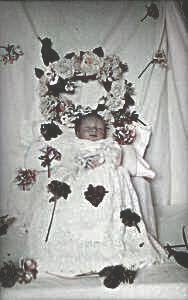
Source: Archivo Ramón Caamaño Bentín. Fotos: "El retrato y la muerte."
Mediateca de RTVE.es, retrieved 4 Nov 2013
Source: Archivo Ramón Caamaño Bentín. Fotos: "El retrato y la muerte."
Mediateca de RTVE.es, retrieved 4 Nov 2013
(Follas Novas, 1880)
The poem reflects De Castro's apprehension at the recurrence of sudden misfortune in her life.
"Negra Sombra" was probably written after two of De Castro's babies died a short time apart. Twenty-month-old Adrian died from a fall in November of 1876 and Valentina was stillborn three months later (Marina Mayoral. "Biografía de Rosalía de Castro." Biblioteca Virtual Miguel de Cervantes).
Negra sombra que me asombras (1.2) and Sombra que sempre me asombras (4.4). The verb asombrar has four definitions in the Galician language: (1) To give shade. (2) To instill dread or fear; to haunt. (3) To amaze, to astound. (4) To be amazed or to be astounded. Only the first two are appropriate here, De Castro dreads the recurrence of sudden misfortune, an apprehension clearly expressed in her poem A Disgracia (poem 11). Therefore these two lines could equally well be translated, "Black shadow that haunts me" (1.2) and "Shadow that always haunts me" (4.4).
At the foot of my head pillows (1.3). Almost certainly depicts the laying down of Valentina's dead body on the pillow beside the mother after giving birth. An earlier translation, To the hem of my head pillows, is more beautiful poetically because of its alliteration but a little less precise: it admits distress for any other motive.
From the very sun you taunt me (2.2). The literal translation is: "On the very sun you show yourself to me," perhaps prefiguring a solar eclipse, but the literal translation is awkward and foils the ambition of preserving the poem's meter and musicality. The chosen translation transmits the emotional pitch spot-on and molds the English text to the arrangement of Juan Montes Capón.
And you are the river's rumour (3.3). The literal translation is: "And you are the river's murmur," but this option forfeits the alliteration present in the Galician "marmurio do río" which the chosen translation reproduces somewhat.
And the night and the dawn (3.4). The literal translation is: "And you are the night and you are the dawn." The removal of the inflection better adapts the translation to the melody of Capón.
The Provincial Museum of Lugo holds the score of the musical adaptation of "Negra Sombra"; the sheet of music dates from 1890-1892.
This poem, "Negra Sombra," became one of the most emblematic Galician ballads ever when composer Juan Montes Capón fused it with an alalá written down in Cruz do Incio (Lugo). The musical arrangement had its debut at Havana's Grand Theatre in 1892. The ballad is arguably one of the most beautiful and prominent in the Galician repertoire; its lyrics so blend with the melody that it is no longer possible to conceive them apart.(Apuntes de "Negra Sombra." Casavaria)
Many artists have interpreted this ballad, eleven selections are offered below.
Orfeón Donostiarra and the Orquesta Clásica del Reino de Aragón. Luz Casal and Carlos Núñez from the soundtrack of the 2004 movie Mar Adentro. María do Ceo Najla Shami from the 2013 album Na Lingua que Eu Falo. Milladoiro from the 1989 album Castellum Honesti (Celtic).Sung in Catalan by María del Mar Bonet
Baritone Antonio Campó (vintage recording). Reviravolta from the 1997 album O Miño Non Pasa Por Escocia. Antoñita Moreno from the 1965 album Ronda de España. Pucho Boedo and Los Tamara from the 1974 album Miña Galicia Verde. Manoele de Felisa from the 1999 album Orballo.|
Cando penso que te fuches,
Cando maxino que es ida,
Si cantan, es ti que cantas,
En todo estás e ti es todo, |
When I think that you have parted,
When I fancy that you've gone,
If there's singing it's you who sings,
Everywhere you are in everything, |